The Creativity and Cognition 2015 Conference Art Exhibition will be open from Monday 22nd - Friday 26th June 2015 (inclusive).
The Address: 7th Floor, Charles Oakley Building, City of Glasgow College, 300 Cathedral Street, Glasgow G1 2TA
The exhibits will be:
Glitching: Beverley Hood
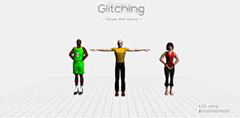 Glitching is a digital installation and performance project led by artist Beverley Hood, that attempts to re-describe the movement derived from characters in contemporary sports and action computer games. Based on the premise of home entertainment dance and fitness training games, it uses the motion-sensor controller, Microsoft Kinect, and large-screen display to create a digital installation for the public to interact with. The exhibition visitor is invited to step into the digital shoes of the 'lead dancer', and attempt to follow the awkward and intricate, glitch choreography performed by the dancing troupe on screen.
Dreams of Mice: boredomresearch
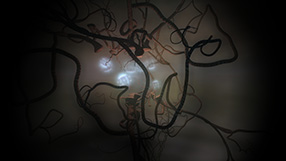 Dreams of Mice explores a changed understanding of sleep brought about by networked technologies. A contemporary world of instant messaging and 24/7 connectivity encourages us to remain permanently available. Using computer modeling, recorded neurological data and game engine technology, boredomresearch http://www.boredomresearch.net ask if we can afford to disconnect; questioning the importance of the non-productive third of our lives we spend asleep. Brain activity during sleep reveals that far from downtime, sleep is complex and beautiful. Developed from research exploring the interaction between environmental factors effecting sleep and human neurological disorders - Dreams of Mice considers the increased control, management and disruption of sleep behaviours. Collaborating with a neuroscientist at the University of Oxford, capturing and recording the dreams of laboratory mice, boredomresearch have revealed the intriguing beauty of slumber in a real-time artwork driven by the firing neurons of dreaming mice (see Fig.1). When we go to sleep we disconnect from our social networks and perpetual status updates, entering the last remaining sanctuary from the demands of a permanently connected and networked society. But is the space of dreams at risk from the relentless encroachment of connective technologies?
Crypto Heater: A Design Fiction: Joseph Lindley
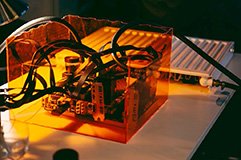 This proposal is to exhibit the work named Crypto Heater which is part of a design fiction [c.f 1,5,8:30] series intended to explore a near future world in which cryptographic currencies such as Bitcoin [6] have become commonplace. This work opens up space for discussion about the activities of the distributed peer-to-peer network of so-called ‘miners’ that ensure the security of the Bitcoin network and regulate the supply of new currency in the Bitcoin economy. The physical part of the work (the heater itself) is set within a fictional near-future reality. In this reality, Bitcoin has become central to our financial service industry, and ‘mining’ in domestic settings is promoted by the government, as a means of heating our homes and to ensure security of the network. A ‘story world’ is constructed using devices such as promotional materials from the UK Government’s Ministry of Crypto Currency; technical specifications; customer testimonials; and the heater itself.
Skin Music: Lauren Hayes
Skin Music (2012) is a musical composition that is experienced as a private, multisensory installation by one person at a time. By lying on a piece of bespoke furniture, the listener perceives the music both through the usual auditory channels, as well as by different types of haptic sensation, through their body. The piece addresses the shared perceptual experiences of sonic and haptic sensation through an exploration of vibrational feedback.
Viewpoints AI: Mikhail Jacob
The Viewpoints AI installation attempts to create an interactive movement-based art experience that has minimal predefined instantial content. As opposed to focusing on designer-created content that reflects their specific view of an interactive experience, we have instead created a movement-based play space where interactors can freely dance with a virtual AI-based character named VAI, teaching it as they interact. VAI analyses interactor movements through procedural representations of the Viewpoints movement theory (from theatre and dance) and improvises responses as an equal collaborator from its past experience with people. VAI uses this procedurally and experientially realized content to present an engaging movement-based experience that any audience member can walk up to and immediately begin dancing with.
COTree - scripting the truth: Lasse Vestergaard
COTree is a physical interaction design installation shaped as a climbing plant. COTree is composed of smart materials, and electronic design tools like Arduino. The installation has leaves that change shape and color depending on CO2 concentrations in the surrounding environment. When the audience experiences a plant withering caused by too much CO2, they become aware that pollution is happening all around us – the audience is breathing the same air as the plant! How do you get away from the pollution, and where should you go?
Hudson Valley Muddy Waters: Using AR to Reveal Microscopic Life in the Macroscopic Forest: Cynthia Rubin
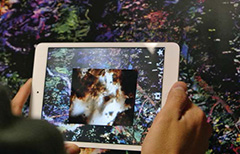 Hudson Valley Muddy Waters makes visible the microscopic life that is key to the health of our forests and streams. The work demonstrates how Augmented Reality and creative imaging can expand the role of the artist in facilitating deeper public connections with the material of science and the macro/microscopic environment.
The artist reverses the usual AR relationship of “real” to “aesthetically mediated” by presenting a painterly digital image as point of departure onto which “reality” is layered, rather than the other way around. Using the app Aurasma, the viewer is prompted to experience the thrill of discovering microscopic life in water via short videos of an actual stream and video micro-captures from the same site.
Dream Vortex: Meredith Tromble
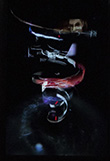 Dream Vortex is a virtual art installation with interactive 3D objects, developed for a CAVE, Oculus Rift, or 3D monitor by artist Meredith Tromble and scientist Dawn Sumner. The central structure is an interactive vortex of hand-drawn dream images that appear in 3D space before the viewer, accompanied by a sound environment. A viewer interacts with the vortex by selecting dream emblems with a game controller. With it, the viewer has the ability to “touch,” move, and compose the images, much like picking up physical objects and moving them around. Once a dream is selected, the vortex disappears; the chosen dream and a suite of related dreams fade into view. For the time span of a typical dream (a few minutes) the viewer can interact with them, moving, resizing, and arranging them in new patterns. The dreams are contributed by the research community at UC Davis, so conceptually the work links “opposites”: subjective and objective knowledge; 2D and 3D space; and our oldest and newest art-making media.
System Self Assembly - Exploring the Self in the City: Andrew Welsby
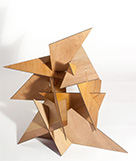 System Self Assembly (2015) is an installation that is the result of a year long auto-ethnographic study. The work explores performative concepts of the self, agency, and the redundancy of the modern medium. System Self Assembly (2015) is a floor based physical installation. Viewers are invited to participate with the construction of the artwork as it evolves. The work comprises 364 wooden triangles measuring on average 40cm x 30cm each. The triangles interlock creating a seemingly amorphous 3-dimensional shape. However, the continuing evolution of the shapes is in fact procedural.al.
Sense-a-Ball Pong: Mark Palmer
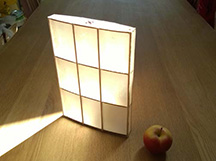 The attraction of classic computer games wasn't their verisimilitude. Games like Battlezone and Elite blended perception and action through interactivity that flowed around the immateriality of the game object; cinematic tropes then emphasised this in films like Tron and Minority Report. Arguably this reveals a facet of perception we have passed over in favour of the fixed outlines of objects. But if this is a part of perception per se rather than being limited to the screen, shouldn't we be able to experience this within the physical world?
Sense-a-Ball Pong explores this by making the classic computer game of Pong ‘physical’. A grid of vanes will orientate themselves towards the ‘ball’ implying its position whilst it will be invisible. Utilising distance sensors player’s will then use their hand to play with the ball. If perception does flow around the object it should become evident in this work.
City | Data | Future: Envisioning Interactions in Hybrid Urban Space: Ingi Helgason
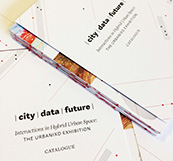 The City | Data | Future installation is a collection of “design fiction” video scenarios that speculate about the experience of urban life and how it might change in the near future. These visions were collaboratively created over the course of an interdisciplinary summer school, exploring the emergent field of urban interaction design. The focus of this field is public space and the relationships between people – with and through technology. Cities in the future will contain a tangled mesh of interlocking data streams, and this complexity is increasingly forming the backdrop to human activities. The installation presents a series of works that invite the viewer to consider how technology might shape the city of the future and subsequently, our relationship with the city, and with each other. The works have been created as part of the UrbanIxD project, which ran between 2013-14 and was funded under the EU FP7 FET Open initiative.
Lichtsuchende: a society of cybernetic, phototropic sunflowers: Dave Murray-Rust and Rocio von Jungenfeld
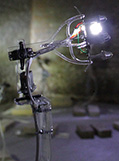 Lichtsuchende is an interactive installation, built using a society of biologically inspired, cybernetic creatures who exchange light as a source of energy and a means of communication. Visitors are invited to engage with the installation using torches to influence and interact with the phototropic robots. The embodied algorithms give rise to emergent behaviours with communicative and emotional resonance, allowing a duet between the humans and the cybernetic beings.
Lucid Peninsula: DreamScope An Interactive Physical Installation: Mara Dionisio
In this exhibit we present Lucid Peninsula, an interactive installation designed to immerse participants in a dreamlike, post-apocalyptic story world. The goal of the installation is to offer a way for people to experience the future through a physical interactive installation. To achieve this aim we designed and developed the interactive DreamScope device, while the Time’s Up collective designed and built the physical installation. On one side with the Dreamviewer binoculars users will be able to see the world outside and absorb data relating to factors such as air quality, presence of plant and other life forms, etc. On the other side of the installation, the audience will be able to borrow mobile devices (Dreamcatchers) and venture into the actual landscape of the city, in order to ‘catch’ the dreams of the inhabitants of the peninsula, which are mixed with memories of the world before it was transformed.
Statuevision: Glasgow: Ali Momeni and Claire Hentschker
 Statuevision is an interactive public projection performance that engages citizens in conversations about urban histories. Statuevision: Glasgow invites participants to explore Glasgow’s history through its iconic statues and monuments. This performance employs interactive technologies that enable participants to animate three- dimensional renderings of the cities statues while learning about the lives of the figures
Exhibition Space
City of Glasgow College
Charles oakley building
300 Cathedral Street, Glasgow G1 2TA, United Kingdom
The exhibition will be held in the original gymnasium that sits on top of an iconic 1960s Glasgow City College building. As a city, Glasgow has a tradition of using alternative “pop up” spaces.


