CC2017 Keynotes
Kumiyo Nakakoji
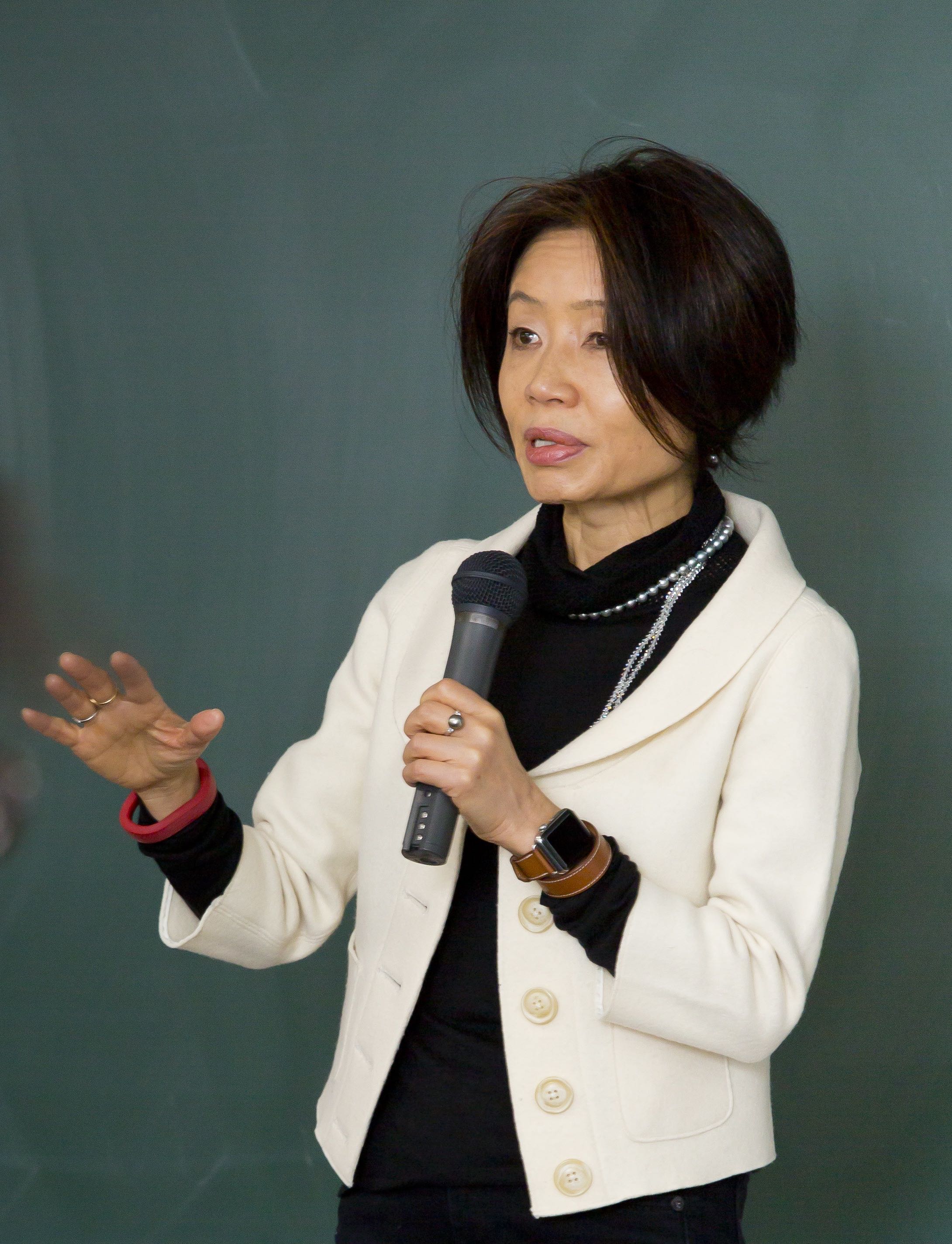
Instrumenting Interaction for Inspiration and Imagination
My research has led me to encounter a series of interesting reactions of people when interacting with visual, physical or logical representations. Such reactions are sometimes predicted or assumed, but many of them are rather eye-opening for me if not mystical. I could reason about such reactions most of the time but the more I encounter such cases, the more I got enchanted by the wonder of human perception and cognition. People get attentive or inattentive, motivated or discouraged, feeling challenged or appreciative, respectful or disrespectful, obedient or disobedient, or excited or bored, not through the functionality that designed interactions convey. It is what people perceive and make sense out of the interactions as the consequence, influence, or effect of the interactions. This talk will share my own excitement of the findings over my prior and current research on knowledge interaction design and collective creativity support. The array of examples to illustrate the findings will lead us to identify fundamental features for interactions to enrich our lives by nurturing inspiration and imagination, which I believe are essential for our creative knowledge work.
Bio
Kumiyo Nakakoji, Professor at Unit of Design, C-PiER, Kyoto University (2013-), is currently engaged with the design of Ph.D. curriculum for Kyoto University Design School. Nakakoji received B.S. in Information Engineering from Osaka University, Japan (1986), and M.S. (1990) and Ph.D. (1993) in Computer Science from University of Colorado, Boulder, certified in Institute of Cognitive Science. She held positions as Adjoint Assistant Professor at Institute of Cognitive Science, University of Colorado, Boulder, USA (1994-2002), as Adjunct Associate Professor at Nara Institute of Science and Technology, Japan (1995-2002), and as Full Professor at Research Center for Advanced Science and Technology (RCAST), University of Tokyo, Japan, where she co-directed the Knowledge Interaction Design (KID) Laboratory (2002-2010), prior to the current position. She also directs the Key Technology Laboratory at Software Research Associates, Inc. Japan. She has served as chairs, editors, and members for numerous research committees, journals, conferences, and government funding agencies, in the fields of Human-Computer Interaction, Software Engineering, and Design and Creativity Support. She was awarded the Distinguished Engineering Alumni Award from College of Engineering, University of Colorado, Boulder, in 2006. Her current research interests include: knowledge interaction design for creative knowledge work, data engagement and experience platform, designing inspirational experience as museum services, and design provenance for collective creativity.
Elizabeth F. Churchill

Material Experience Research
—Evidentiary Encounters with Creativity—
Creativity is often associated with free expression, dynamic innovation, originality, and insightful, unconstrained genius. Nowhere is this more so than in the practice of Design (with an emphatic, capital ‘D’). The embodiment of this myth is the genius designer, from whom creative ideas spring forth naturally, effortlessly. A companion myth within the world of interface and interaction design is that design and user experience experimentation are not allies in creativity; rather, user experience research is in service of creativity, laying the foundations for design inspiration by identifying “gaps” and “needs”, or providing summative evaluations of designs. To the first myth, the creative process actually involves effort, exploration and iteration; creativity is enacted and accomplished in design practice through the judicious application and relaxation of understood and discovered constraints. Constraints help you ask better questions, not simply drive for solutions. Good examples are design systems and frameworks that codify carefully thought-out, and frequently observed constraints; they codify principles and best practices, they inform, and they offer useful boundaries that provoke design exploration and challenge. To the second, experimentation is a creative act in itself; systematic experimentation can and should be intimately woven into iterative design processes. Experimentation allows options to be tested and explored. Experimentation enables thoughtful exploration of permutation. In this talk I will share stories of collaboration between my team, Material Experience Research, and the designers and developers of Material Design (material.io). I will talk about tools for “creatives”, and the ways in which such tools can enhance rather than constrain and restrict creative exploration. I will discuss research we have been conducting on how good design and user experience principles, codified within design frameworks and systems, spark creativity through provisional constraint.
Bio
Dr. Elizabeth F. Churchill is a Director of User Experience at Google. Her current work focuses on designer and developer tools for interaction design, and on the connected ecosystems of the Internet of Things. For 2 decades, Elizabeth has been a research leader at wellknown corporate R&D organizations including Fuji Xerox’s research lab in Silicon Valley (FXPAL), the Palo Alto Research Center (PARC), eBay Research Labs in San Jose, and Yahoo! in Santa Clara, California.
She has contributed groundbreaking research in a number of areas, publishing over 150 peer reviewed articles, coediting 5 books in HCI related fields, contributing as a regular columnist for ACM’s interactions magazine since 2008, and publishing two co-authored books: Foundations for Designing User Centered Systems (Springer 2014) and Designing with Data (O’Reilly 2017). She has also launched successful products, and has more than 50 patents granted or pending.
A Distinguished Scientist and Speaker of the Association for Computing Machinery (ACM) and a member of the CHI Academy, Elizabeth is the current Secretary/Treasurer of the ACM. She served in the ACM SIGCHI Executive Committee for 8 years, 6 years of those as Executive Vice President. Elizabeth sits on the advisory board of a number of University Departments, and has just joined the Council of The Computing Community Consortium. In 2016, she was the recipient of the CITRIS and Banta Institute Athena Award winner for Executive Leadership.
Sonny Liew

The Art of Kenny Who?
Sonny Liew talks about his own early experiences creating comics, and how the technology has changed the way the artform is created and delivered. We are at a stage now where digital and analog tools can be combined according to our own tastes, to find the right mix that utilizes the speed and efficiency of digital tools while preserving the handmade qualities of analog ones. But are we are currently at a liminal stage, and will comics be affected by the AI/Robot revolution to come? Perhaps heralding a time when the industry has a hollowed out middle, with high-end creators and very cheap human labour still able to find a foothold, but with the rest (and majority) replaced by machines. While this is still a semi-science fictional scenario, it is also one that involves real and urgent questions about human endeavor and where we will end up, pulled along as we are by our own contradictory natures.
Bio
Sonny Liew's The Art of Charlie Chan Hock Chye was New York Times bestseller, and the first graphic novel to win the Singapore Literature Prize. Other works include Malinky Robot, Doctor Fate (with Paul Levitz) and The Shadow Hero (with Gene Yang), along with titles for Marvel Comics, DC Comics, DC Vertigo, and Image Comics. He has been nominated for multiple Eisner Awards for his art, as well as for spearheading Liquid City, a multivolume comics anthology featuring creators from Southeast Asia. Born in Malaysia, he lives in Singapore.